Monday, 14 August 2017
Finnish Cavalry in the Swedish Era
An 800-page history of Finnish cavalry from 1550 to 1809 — Matti J. Kankaanpää's major work and the first comprehensive treatment of the subject in Finnish.
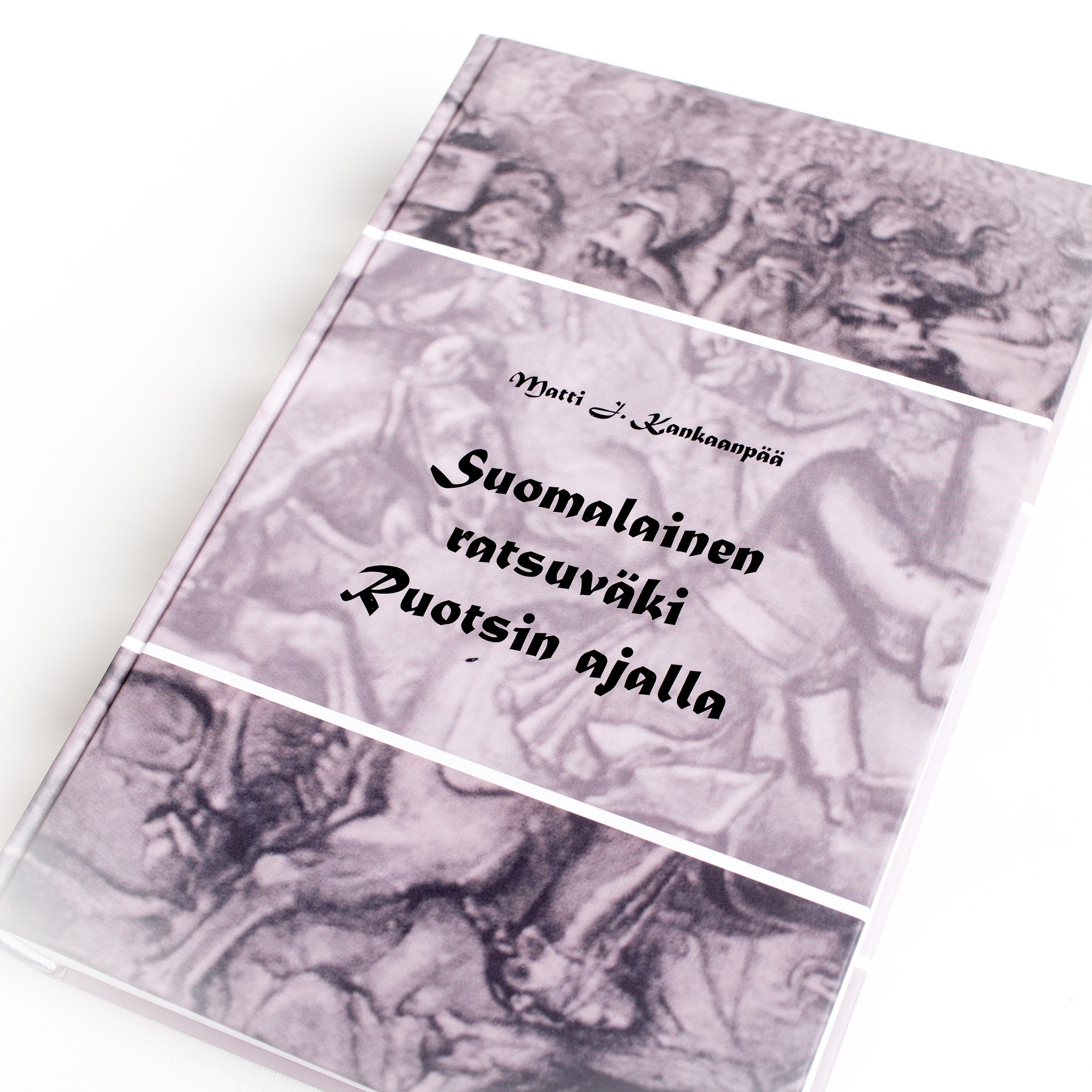
Suomalainen ratsuväki Ruotsin ajalla
2016 · 790 s. · ISBN 978-952-99106-9-4
Ensimmäinen kokonaisteos suomalaisesta ratsuväestä n. 1550–1809. Kirja painottuu suuren Saksan sodan vuosiin ja muihin 1600-luvun sotiin. 790 sivua faktaa, nimiä, paikkoja ja tilastoja.
The 800-page work on Finnish cavalry covering the years 1550–1809 was Matti J. Kankaanpää’s most significant and final major work. Few books treat Finland’s military campaigns with this level of detail in a single volume — the first of its kind in Finnish.
The book provides a detailed comprehensive picture of the activities and composition of ethnically Finnish cavalry from the 1550s to 1809.
A Modest Beginning — the Poles Taught Us
Everything began modestly, when during Gustav Vasa’s Russian War in the 1550s a separate troop of Finnish horsemen was formed. Two and a half centuries later, during the Finnish War, cavalry was scattered in small companies throughout the army. At its greatest, around the very start of the 18th century, Finnish cavalry including dragoons — after a full doubling and the establishment of additional units — numbered over 7,000. Those years contained a great deal.
For cavalry development, the wars against Poland were more significant than those against Russia. Poland-Lithuania’s cavalry was the finest in Europe. Through catastrophes — such as Kirkholm in 1605 — they slowly but surely learned to fight on horseback. Gustav Adolf’s reforms made the army efficient.
Finnish cavalry played the leading role when the Polish-Lithuanian cavalry army was defeated at Wallhof in 1626. The method of fighting with fierce charges in close formations had been learned from the Poles, whose primary weapon was the lance. Swedes and Finns trusted their long-bladed swords. Pistols were a supplementary weapon. With officers at the front, the squadron charged at full gallop, sword in hand, straight at the enemy — to thrust, not to cut.
The Thirty Years’ War
When Sweden entered the great German War (1630–1648), cavalry was the arm that won countless skirmishes and decided field battles. Armies grew large and national troops — Finnish and Swedish — became a minority within them. For Finnish cavalry the most significant of the great contests were Wittstock 1636 and Leipzig 1642. Finnish cavalry squadrons came by ship across the Baltic to Pomerania and from there rode across to the Rhine in the west, to the shores of Lake Constance and Bavaria south of the Danube, and in the east to Bohemia, Moravia and Silesia.
Three Northern Wars
The Thirty Years’ War was followed by three wars under three different King Charles. These Northern Wars were hard but very different from one another. Under Charles X Gustav (1655–1660) campaigns were fought in Lithuania, Poland, Denmark, the Baltic provinces and Finland. Under Charles XI (1675–1679) — the Scanian War — the Pomeranian and Prussian theatres were also significant for Finnish units.
Under Charles XII, the third Northern War is known as the Great Northern War (1700–1721), the subject of a separate book (Suuri Pohjansota, 2001). After that war, all cavalry in Finland was of the dragoon type. Subsequent wars were fought within the kingdom’s borders.
Finland at the End
The significance of cavalry changed. The terrain of Finland — many lakes, large bogs, dense forests — did not suit cavalry squadrons. In 1790 the Life Guard Dragoons and the Uusimaa and Häme cavalry were ordered onto the vessels of the archipelago fleet. Horses were transferred to the artillery. The cavalrymen served as marines in both the Viipuri gauntlet and the famous Battle of Ruotsinsalmi.
In the 1790s over half the cavalry was converted to infantry. The remaining cavalry took part in the Finnish War, and the last were present when von Döbeln bade farewell to the Finnish troops in the town square of Umeå on 8 October 1809.
Structure
The book alternates between narrative chapters on the campaigns and dense reference chapters organised by unit. Those interested in the broader development read the former; those searching for a specific unit and farm allotment look in the latter, where detailed source citations appear as footnotes. The book need not be read in order — the opening pages are recommended as an introduction, after which one can focus on whichever war period is of interest. In this sense the book is a reference work for the library of anyone interested in the period.
This book is a companion to the same author’s book on the Great Northern War (1700–1721): Suuri Pohjansota, iso viha ja suomalaiset (2001).