Friday, 20 September 2019
The Oldest Parish Registers of Tyrvää 1693–1722
The book Tyrvään vanhimmat rippikirjat 1693–1722 has long been sold out and is now available as an e-book — an unusually rich early source for genealogists researching families from Tyrvää, Kiikka and Kiikoinen.
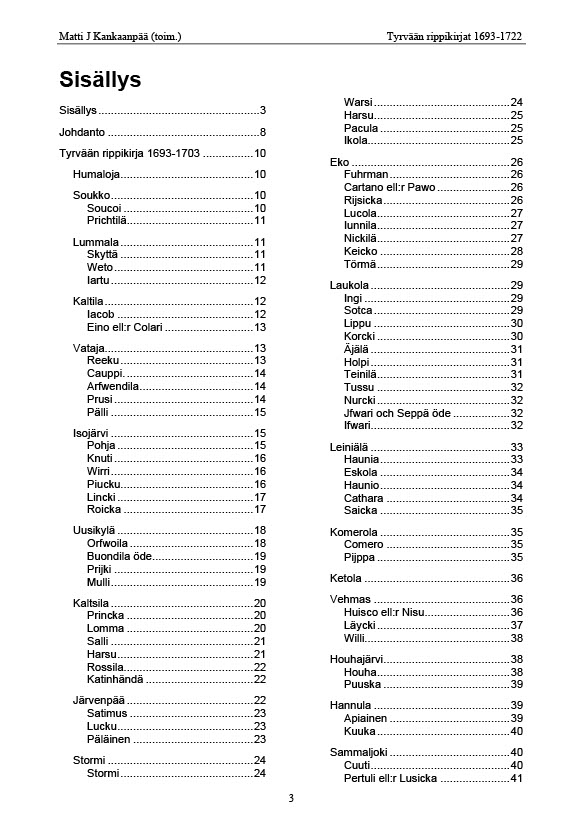
Tyrvään vanhimmat rippikirjat 1693–1722
2004 · 229 s. · ISBN 952-99106-4-9
Tyrvään seurakunnan vanhimmat rippikirjat painoasussa. Tärkeä lähde Satakunnan sukututkimukseen.
The book Tyrvään vanhimmat rippikirjat 1693–1722 has long been sold out. It is now available as an e-book.
Below is the author’s own introduction.
Introduction
Genealogists researching the families of Tyrvää and the areas separated from it — Kiikka (chapel from 1662) and Kiikoinen (chapel from 1847) — have access to exceptionally old and information-rich church records. The history books begin in Tyrvää from 1693 and in Kiikka from 1698; before the latter date, information on Kiikka and the associated Kiikoinen areas is found in Tyrvää’s history books. And what is especially notable: the records continue almost without interruption right through the notorious Great Wrath.
The oldest register volumes edited here (F1–2) cover Tyrvää from 1693–1703 and 1705–1722. The next surviving volume (F3) is not until 1730–50. Note that the older Tyrvää volume also includes the Kiikka and Kiikoinen areas. Kiikka, from which Kiikoinen was later separated, has its own registers from 1699 onwards. I have begun preparing those for a separate publication to cover up to 1725, but printing will depend on the commercial success of this Tyrvää volume.
The primary reason I chose these particular registers to edit is their remarkable source value. For records of their age, they contain an unusually large number of birth dates, death dates and migration entries. Most migration entries are within the parish. The oldest Tyrvää register was microfilmed so darkly that the text at both margins was very difficult to read. The original book might be more legible in that respect, but comparing them was not possible for cost reasons. Many passages have therefore had to be marked with a question mark, and regrettably many have been left entirely unread, marked ( ). It would be advisable for the reader to use this book together with the microfilm. Some unread and uncertain passages may be clarified through other sources such as history books and poll tax rolls (SAY). I have checked a few details against history books but have wanted to keep separate the source value of a single source and the research that combines information from multiple sources. This publication aims to be a source publication, not a research work.
The Famine Year 1697
The church history books are not sufficient for clarifying all passages. If a death year is 169(7?), for instance, it may not be found in the burial register even if one exists — the priest sometimes had so many to bury that he could not record each one separately. On 10 May a mass burial of 17 bodies was conducted without naming them; 40 bodies on 27 May; 20 the following day; 30 bodies on 9 June; 23 on 13 June; 8 on 16 June — 138 in all. In addition, 239 individuals were buried in Tyrvää that year. From the communion register one can find farms from which entire families died in a single year.
Judging by the communion registers, the famine year of 1697 was far more severe in the Tyrvää area than the Great Northern War and Great Wrath that followed shortly after. The Great Wrath period appears mainly in the sparseness of communion records, particularly in 1714. Soldiers are noted in some cases as having died in Riga (död i Riga); one or two in Viipuri and Narva. Many soldiers were apparently simply underlined or crossed out as a mark of migration.
Structure of the Registers
The oldest Tyrvää register (1693–1703) is in practice an age book rather than a true communion register — it tracks ages rather than communion attendances, with an age census apparently made in 1694. The Kiikka register (1699–1716) and the second Tyrvää register (1705–22) are proper communion registers. Communion attendances are tracked in three periods: in Kiikka, 1699–1704, 1705–10 and 1711–16; in Tyrvää, 1705–10, 1711–16 and 1717–22.
In the edited text, communion attendance is noted in the same abbreviated form used in my earlier Greater Ruovesi publications: for instance, 705–10 means that the person attended communion every year from 1705 to 1710. Where a specific date has particular significance it has been included.
Virrat, 29 August 2004
Matti J. Kankaanpää